
2025 · AI · Healthcare
Reducing doctors' documentation time by 75% with AI
Designed an AI-powered clinical documentation experience that helped doctors move from writing medical notes to reviewing AI-generated ones, supporting 6,173 consultation starts across five pilot hospitals in its first month.
Role
Lead Product Designer
Team
Kerry (Frontend Lead) · Stanley (Backend Lead) · Osasu (AI & Data Engineer) · Taiwo Osinubi (PM)
Timeline
2025 Q3–Q4
Category
AI · Healthcare
6,173
Consultations started in the first month
63.3%
Consultation completion rate
~650 hrs
Estimated documentation time saved
~75%
Estimated reduction in note-taking time
The problem
In a busy Nigerian hospital, doctors can spend 20–40 minutes documenting a consultation after a patient leaves. Multiply that by 12 patients daily, and documentation becomes a second job.
Doctors reconstruct conversations from memory, often losing important clinical details. Notes become generic, incomplete, or delayed, affecting continuity of care.
We spoke to 5 doctors across 5 Nigerian hospitals
We interviewed doctors at hospitals already using HeliumOS, our Electronic Medical Record (EMR) system.
Three problems stood out:
- Delayed documentation: Doctors write notes after consultations, when clinical details are already fading.
- Incomplete records: Time pressure leads to shorthand and missing information needed for follow-up care.
- Compounding clinical risk: Incomplete notes accumulate across consultations, making continuity of care harder.
Why AI and not better templates?
We explored custom SOAP forms within HeliumOS, allowing doctors to create templates for different consultation types. But doctors still had to manually document every consultation.
Voice-to-text wasn't enough either. Raw transcripts contained small talk, irrelevant details, and unstructured clinical information.
The problem wasn't the form. It was the act of authoring.
AI could interpret conversations, extract clinically relevant information, and generate structured notes without doctors writing everything themselves.
Designing the solution
We designed Helium Scribe as a reusable AI-powered widget, initially integrated into HeliumOS.
This was both a product and business decision. The widget architecture allowed us to:
- Own the technology: Maintain control over the AI experience and underlying tech stack.
- Integrate across products: Reuse Helium Scribe across other Helium Health healthcare products.
- Create a standalone business: Offer the widget to healthcare partners and third-party EMR providers.
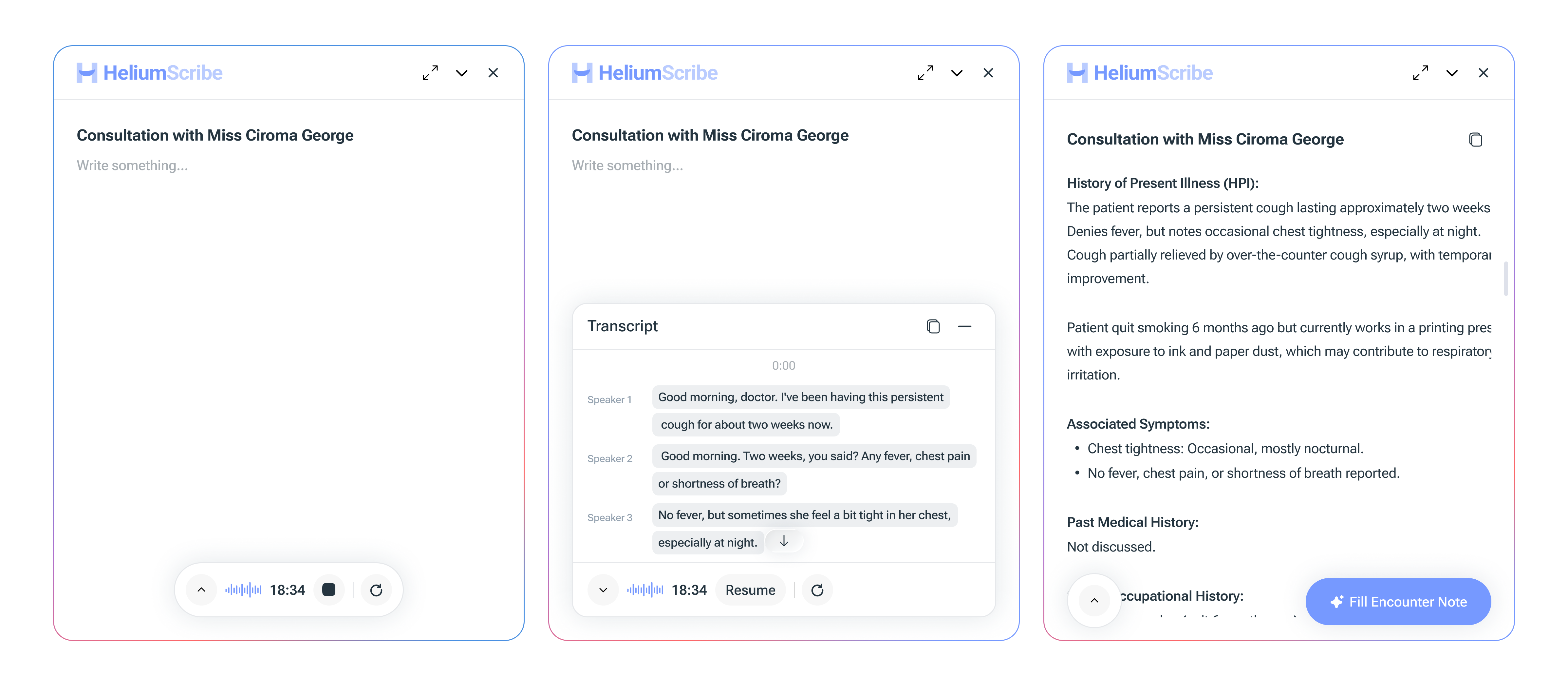
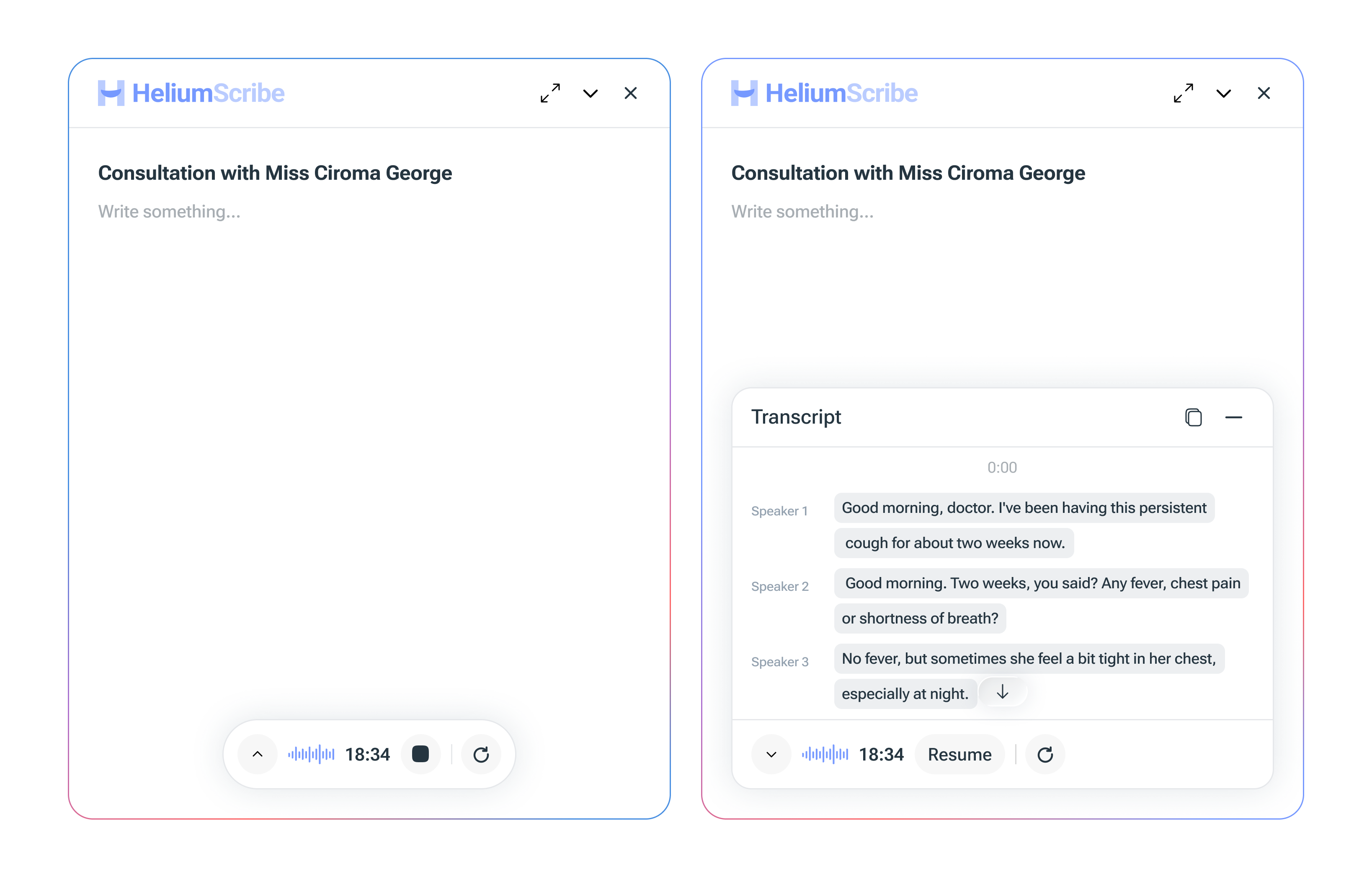
The experience followed a simple workflow: Start consultation → Capture conversation → Generate note → Review and approve.
Helium Scribe listens during consultations and generates structured SOAP notes (Subjective, Objective, Assessment, Plan), matching doctors' existing documentation workflows.
Three design decisions were critical:
- Confidence flagging: Highlight uncertain or incomplete information for review.
- Section-level editing: Let doctors edit or regenerate individual sections without losing accurate content.
- Doctor approval: Require explicit approval before saving AI-generated notes to patient records.
Our goal was to shift doctors from writing clinical notes to reviewing them.
Then we hit a wall
Our first implementation of Helium Scribe was a desktop widget within HeliumOS.
During early testing, Dr. Lateef Akinola, Consultant Obstetrician and Gynecologist at Medison Specialist Women's Hospital & Fertility Assyst, challenged our biggest assumption.
Not every doctor works from a desk.
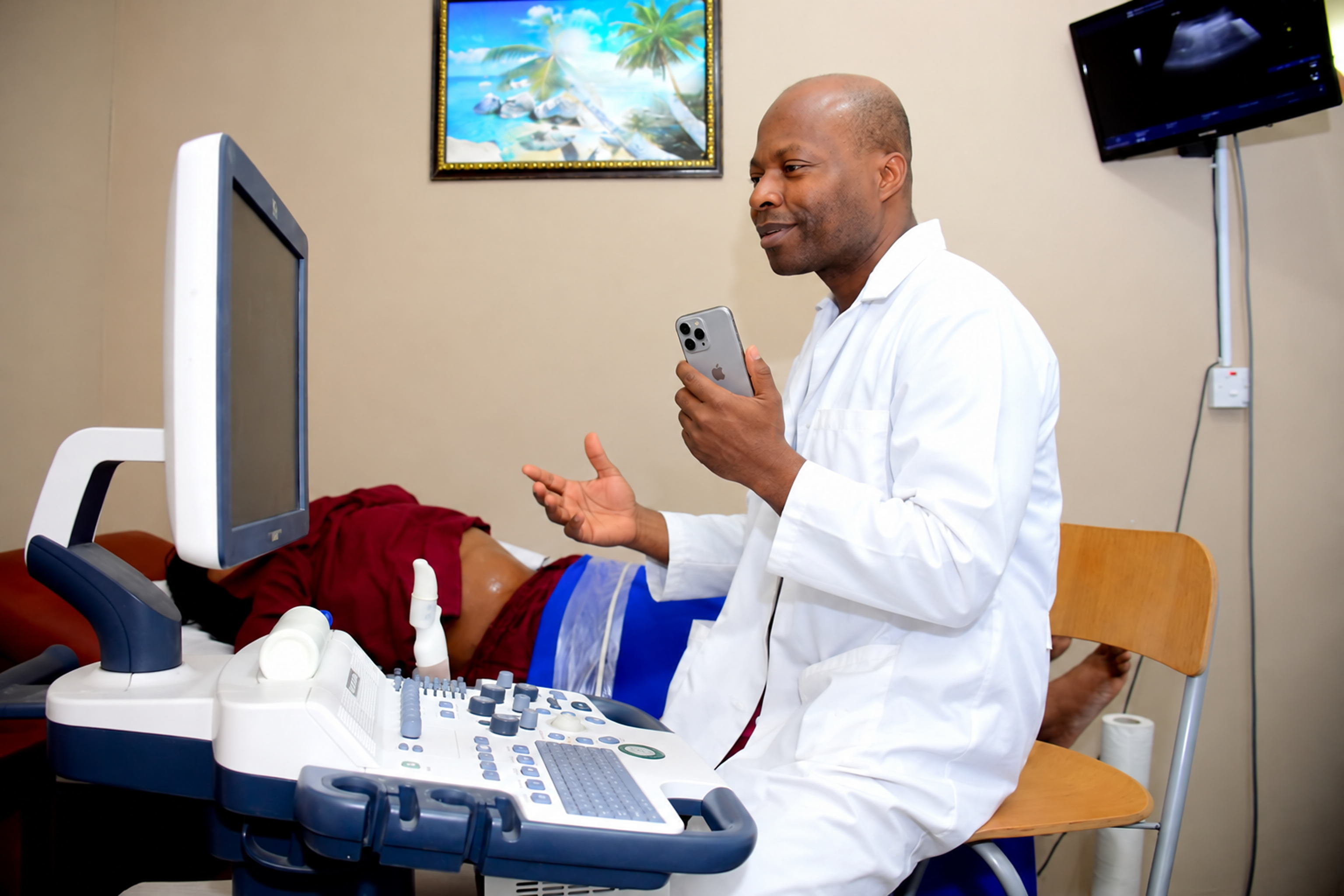
He moved between wards with his phone, rarely using a laptop during consultations. Other doctors also reported that laptop microphones picked up too much background noise, affecting transcription accuracy.
Our desktop-only experience didn't reflect how doctors actually worked.
Building a mobile companion
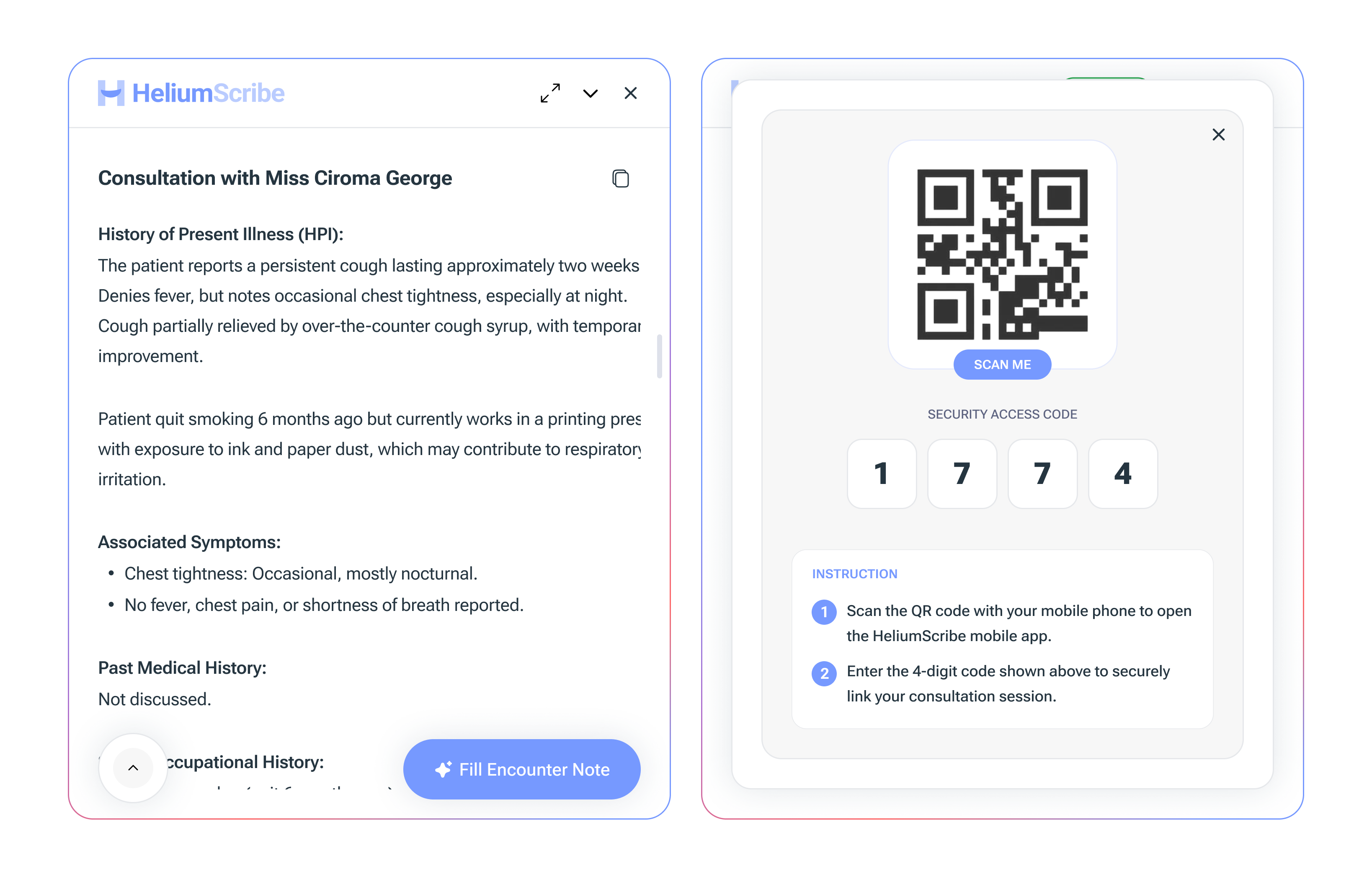
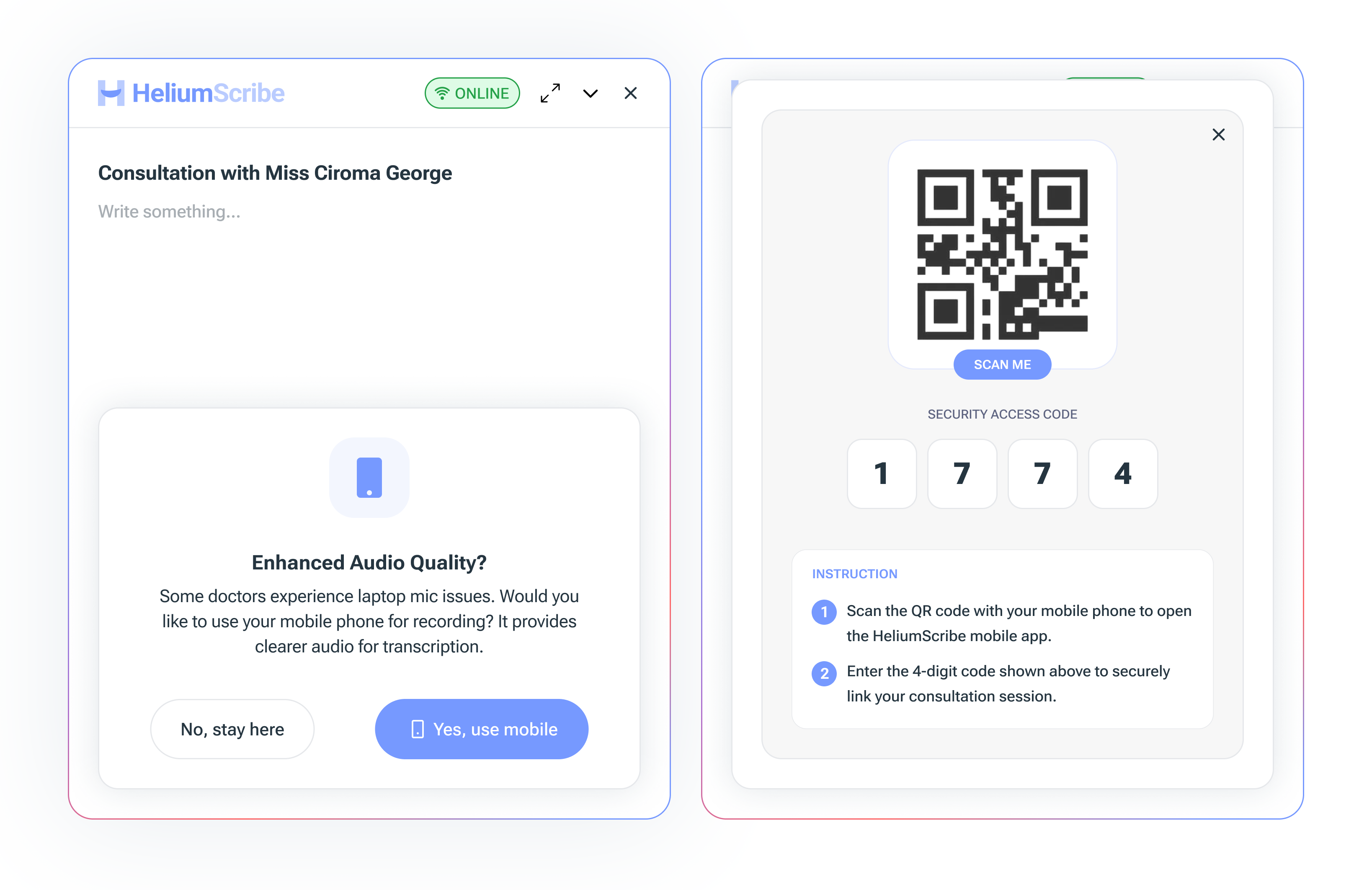
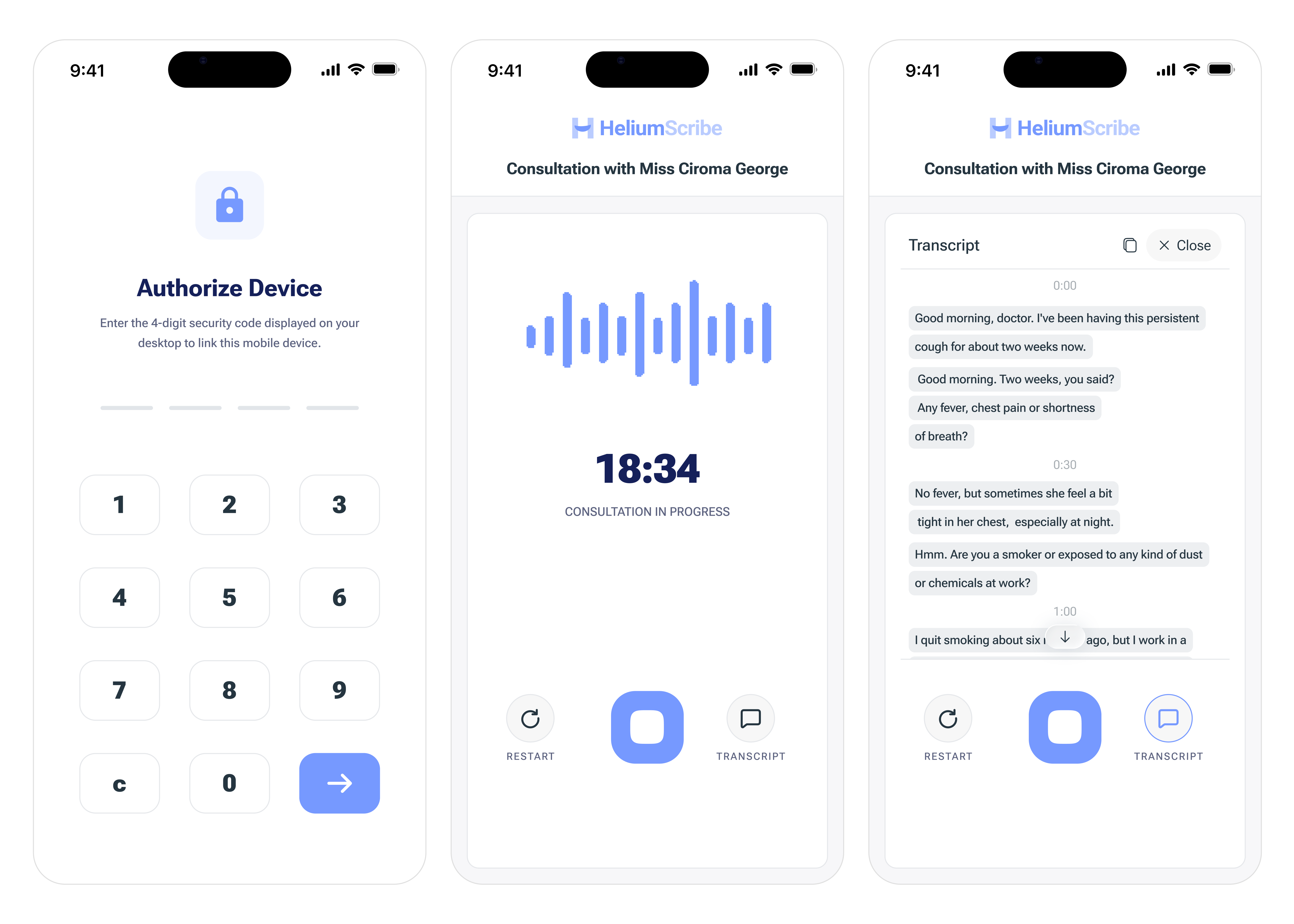
We designed a mobile companion app that connects to the Helium Scribe desktop widget using QR code pairing and PIN authorization.
The workflow became:
- The doctor opens a patient record and scans the QR code.
- The mobile app securely pairs with the EMR session.
- The phone captures consultation audio as the doctor moves.
- Helium Scribe generates a draft note in the desktop EMR for review.
This allowed doctors to record consultations at the bedside and return to completed drafts without carrying a laptop.
The consent problem
One of our toughest challenges wasn't AI accuracy. It was patient consent.
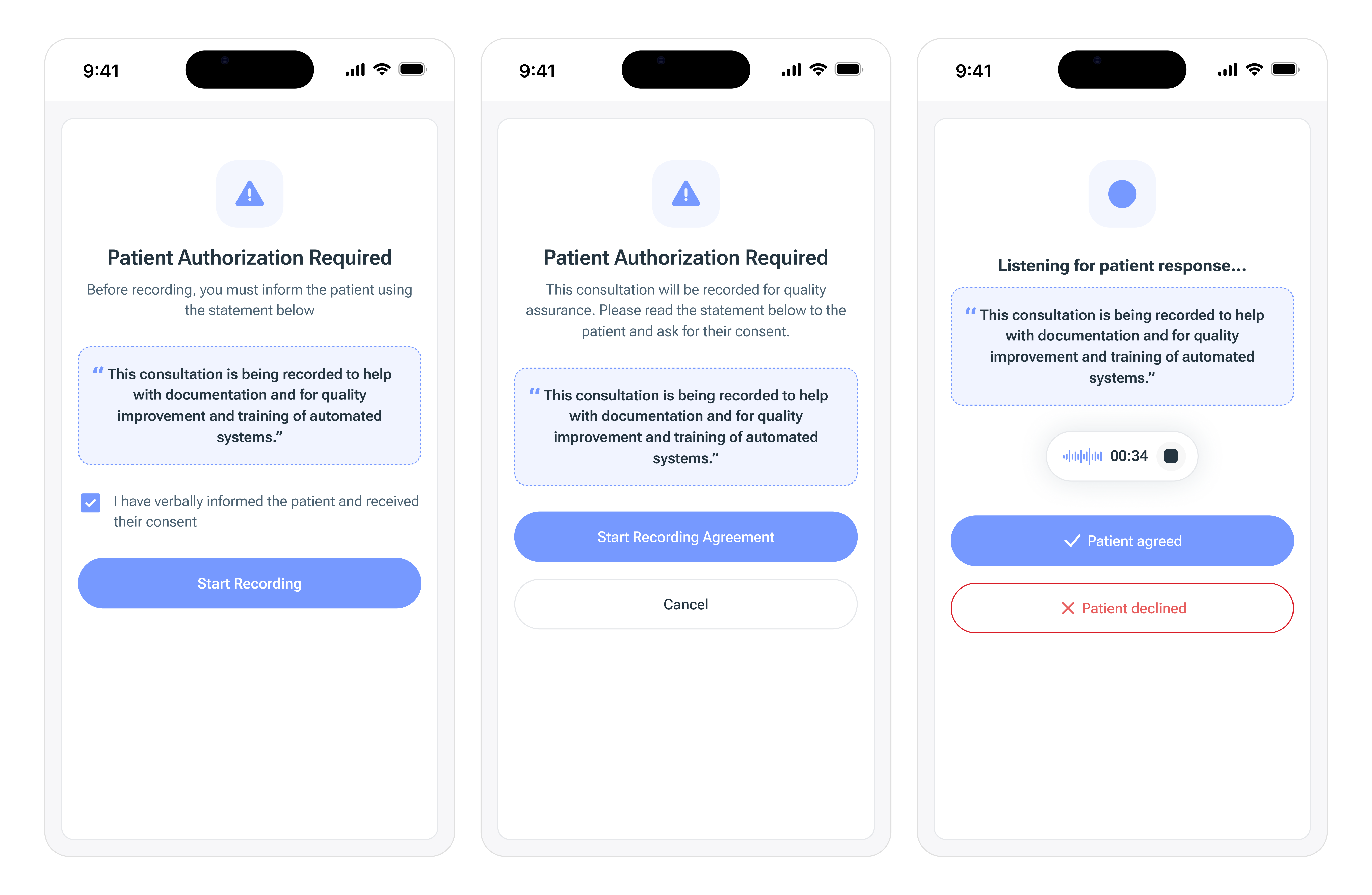
Patients were being recorded without directly interacting with the app. We needed doctors to obtain verbal consent before recording without interrupting the natural consultation flow.
After several iterations, we designed a clear consent prompt that fit naturally into the start of each consultation.
Designing for accountability
Every consultation documented using Helium Scribe was tagged as AI-assisted in the patient record, allowing audit teams to identify and review AI-generated documentation.
Combined with explicit doctor approval, this kept clinicians in control of the final medical record.
Results and impact
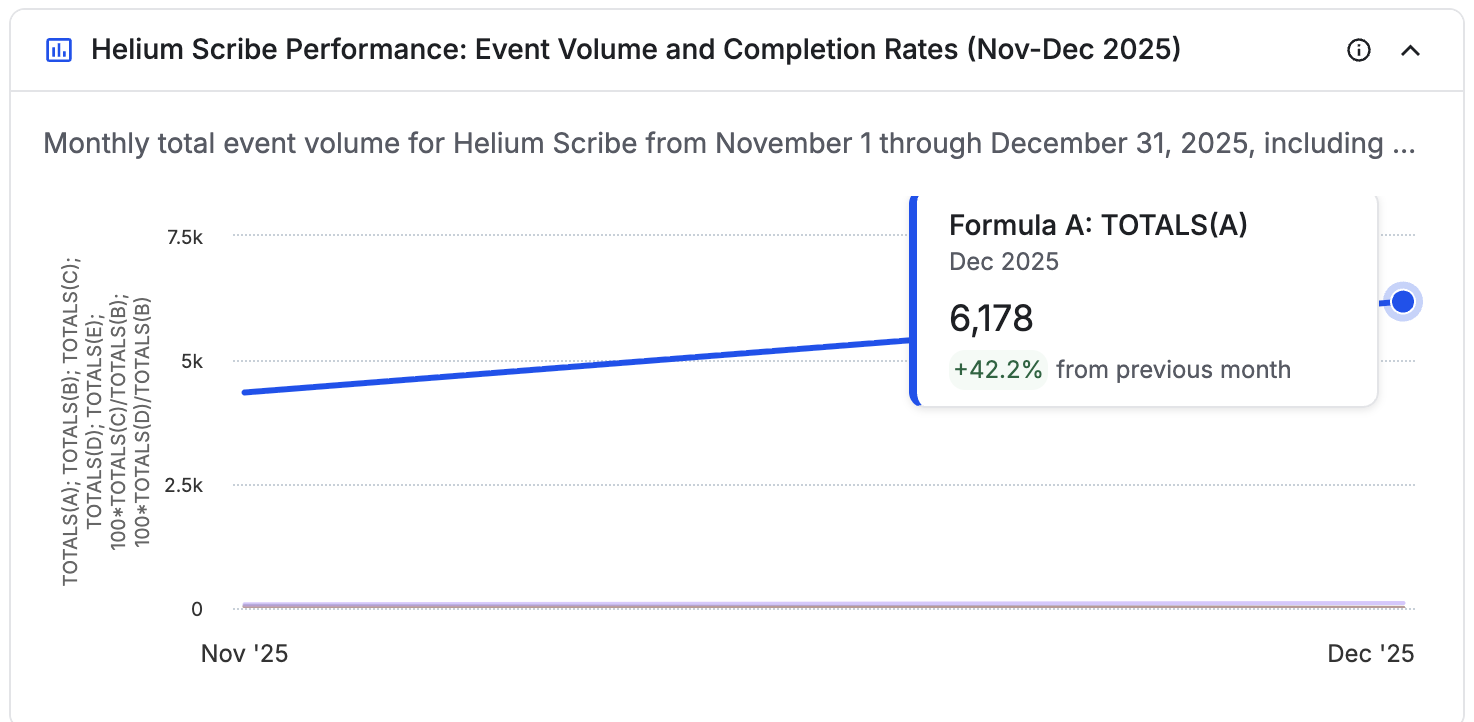
6,173 consultations started across five pilot hospitals within the first month of launching HeliumScribe, with a 63.3% completion rate.
~650 hours of clinical documentation time potentially saved, based on completed consultations and doctors' reported reduction in note-taking time from 12–15 minutes to just 3–4 minutes.
Doctors reported spending less time documenting consultations and feeling less exhausted after clinic hours.
The biggest change wasn't just faster documentation.
It was moving doctors from writing clinical notes to reviewing and refining AI-generated documentation.
What I learned
Clinical usefulness matters more than technical completeness.
Early AI-generated notes were grammatically correct and structurally valid, but doctors sometimes found them lacking clinical depth and appropriate medical terminology. Working directly with clinicians helped us make the documentation more clinically useful, with further refinement still needed.
Real workflows challenge design assumptions.
The mobile companion came directly from observing Dr. Lateef Akinola's workflow. That experience reinforced why designing around actual clinical practices matters more than relying on assumptions about how doctors work.
What I'd improve next
Build for Nigeria's multilingual clinical environment.
During the pilot, we discovered that consultations frequently involved Yoruba, Igbo, Pidgin, and other local languages alongside English. Our initial AI model couldn't reliably handle these conversations, limiting its usefulness for some doctors.
Expanding local language support and improving clinical terminology became key priorities for making HeliumScribe more reliable across different consultation settings.
More case studies
Shuffle through more product work and the decisions behind it.
Streamlining bank account creation: From weeks of paperwork to a 21-minute digital process
Tride helps non-profit organizations open and manage bank accounts. I designed an onboarding experience to help NGOs get an account sooner, without weeks of paperwork and back-and-forth.
How user research helped turn EnergyStack into a $450K+ business
Led product design from discovery to launch, transforming a vendor-led solar marketplace into a financing-powered commerce platform that generated $450K+ in sales.
Read case study